
We are in the final stretch of the CrowdSale for UnderQuest. Only 4 days remains to get your copy for 43% off! That’s just $48 for your copy! Now is the time to get on board, as the price will never be this low again.
We are in the final stretch of the CrowdSale for UnderQuest. Only 4 days remains to get your copy for 43% off! That’s just $48 for your copy! Now is the time to get on board, as the price will never be this low again.
UnderQuest CrowdSale is Alive! The time has finally come! Everyone can save 43% on their copy if we get enough backers, so please share this and help spread the word! The more backers, the lower the price is for everyone! Thanks for all of your continued support through the creation of this game.
https://www.thegamecrafter.com/crowdsale/underquest
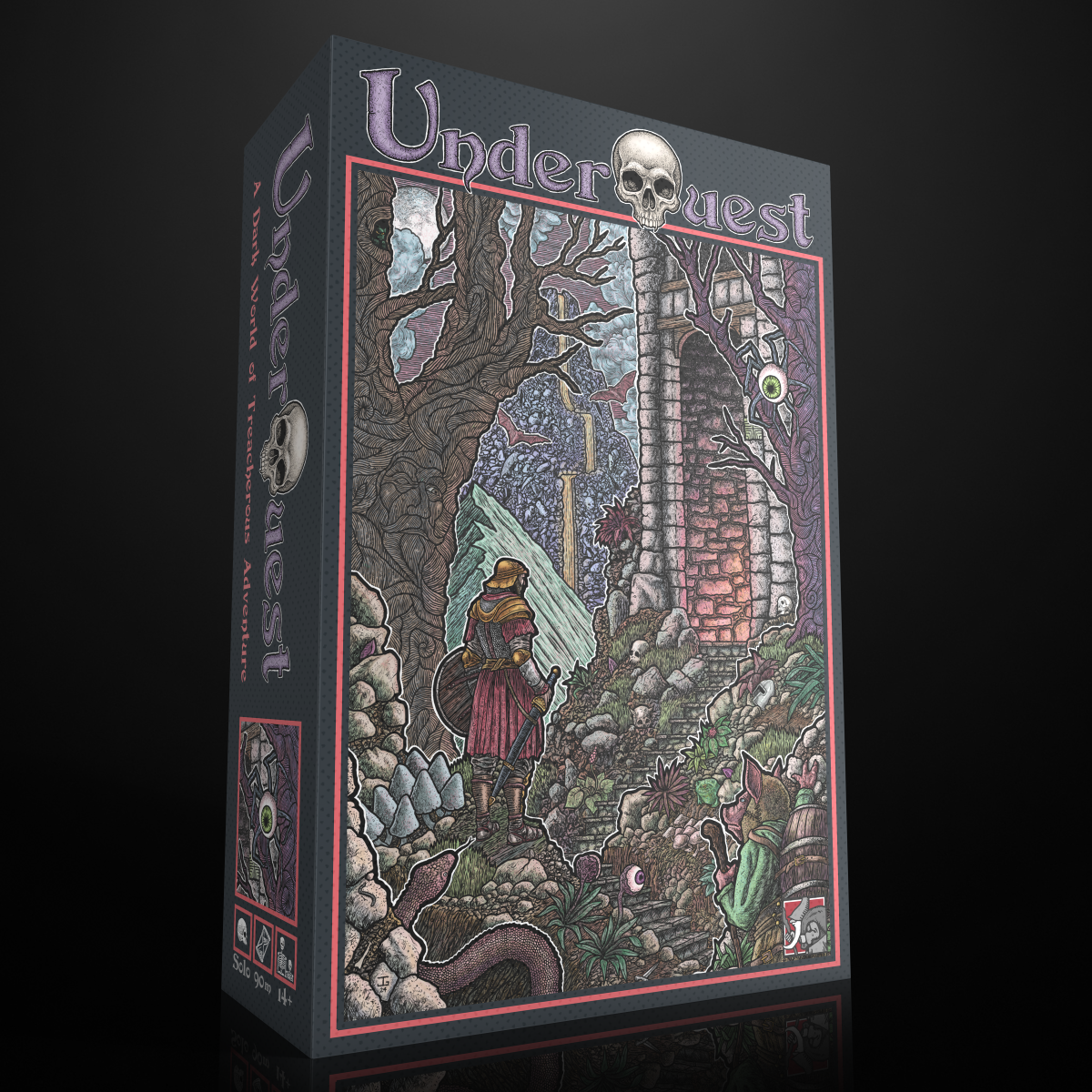
Mark your calendars, the CrowdSale for UnderQuest will be launching January 13th! Hit the REMIND button on the page to receive an email when it goes live! I am super excited about the tweaks we made and the game is going to be super fun! Dustin just got his new copy, so we should have a few videos up before launch! WOOT!
https://www.thegamecrafter.com/crowdsale/underquest


Most of you know by now that the Crowdsale for UnderQuest was cancelled. The sale was moving along better than I had expected at the time. Dustin Cox (from the Game Knight YouTube Channel) reached out to me after having played it a few times and he had some suggestions. UnderQuest was at a good point during the Crowdsale, but Dustin had a few ideas that could make the game a bit crisper. I toiled over it for a day or two and ultimately decided I wanted the best version of UnderQuest possible to be put in the hands of customers, so I cancelled the release in order to make changes to the game. It was a humbling experience for me, but I knew I had to do it in order to make UnderQuest the best it could be.
I have been trying to make a post about this on the site for a few weeks, but I had issues logging into this account until today. That is the reason it has taken a bit of time to post something here. The silver lining is that in this time I have worked very hard with Justin Cox on making UnderQuest a fantastic game that I can be very proud of. I have decided to make Dustin a co-designer of UnderQuest for his efforts and ability. So let’s take a look at a few of the issues we were dealing with and our solutions.
MAGIC DAMAGE. Probably the biggest issue was the damage system for magical attacks. The player was simply doing too much damage once they got their hands on a magical weapon. The solution was to adjust some f the damage output of some weapons and alter the way magic damage is dealt. We have dozens and dozens of playtests in with these changes and the system works flawlessly. Before combat was closer to that of iron Helm, where you could often one-shot enemies. This system has most battles having a good back and forth fight, which feels better than before.
CHARACTER AND ENEMY HEALTH. Before enemies and your character has less health than they do now. Combat is more manageable now. You are not going to one hit enemies as much and you will be able to take more damage. Characters will start with about 10 extra health, which is the perfect amount. Enemies used to add the dungeon level to their health, now they add double the dungeon level to their health.
MORALITY SYSTEM. The morality system in UnderQuest was certainly better than it was in Iron Helm, but it wasn’t perfect. Often making the evil choice was better in the long run. We made some changes there by altering a few cards and adding some new cards like the ones below. Having negative morality will now haunt you more than before, while making good choices can lead to some great rewards. That was always the goal. Being evil helps you in the present, and being good potentially pays off in the end. Kind of like real life.
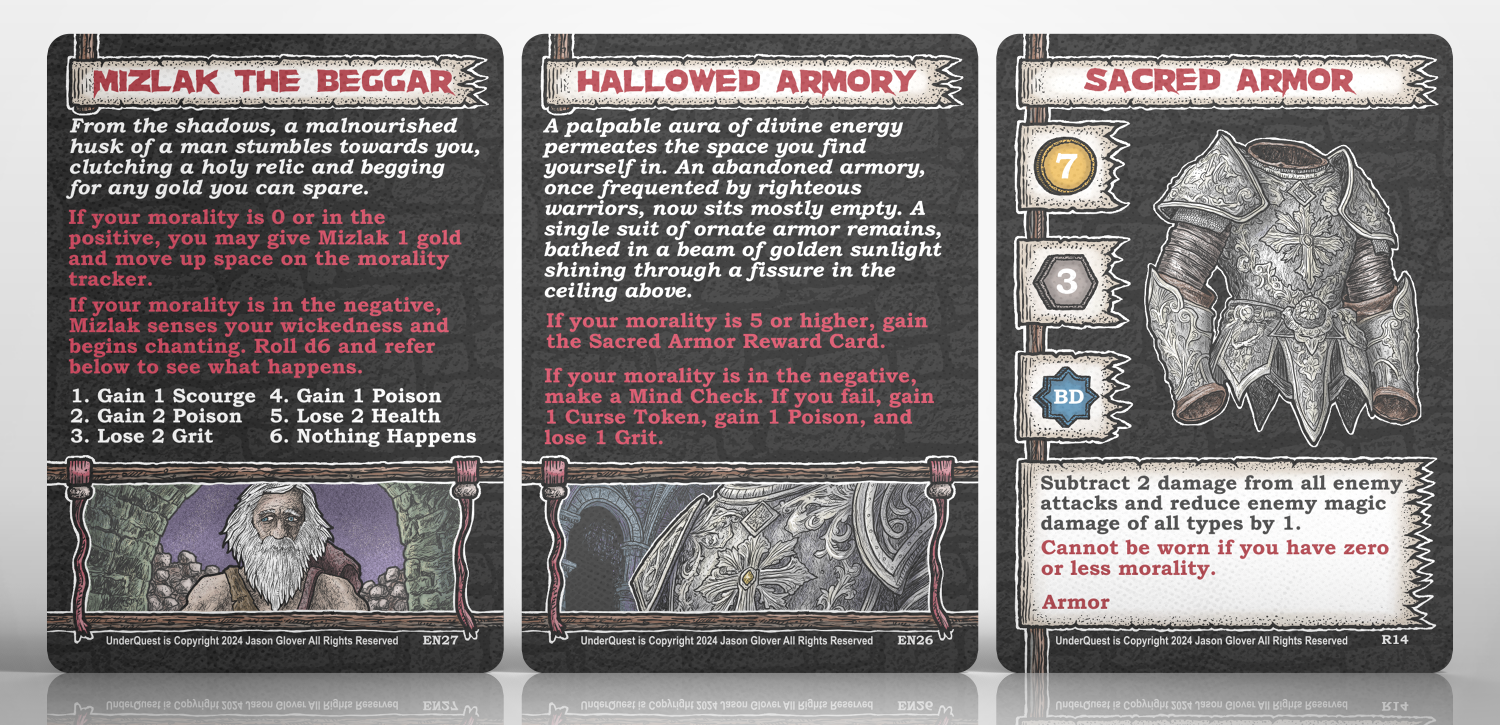
STARTING WEAPON. We also decided to give each class a starting weapon, so the player didn’t have to spend gold at the beginning of the game on a weapon. We also replaced the starting trapping on the race card with a simple bonus item like a ration or ingredient. We designed two new trappings cards for this purpose.

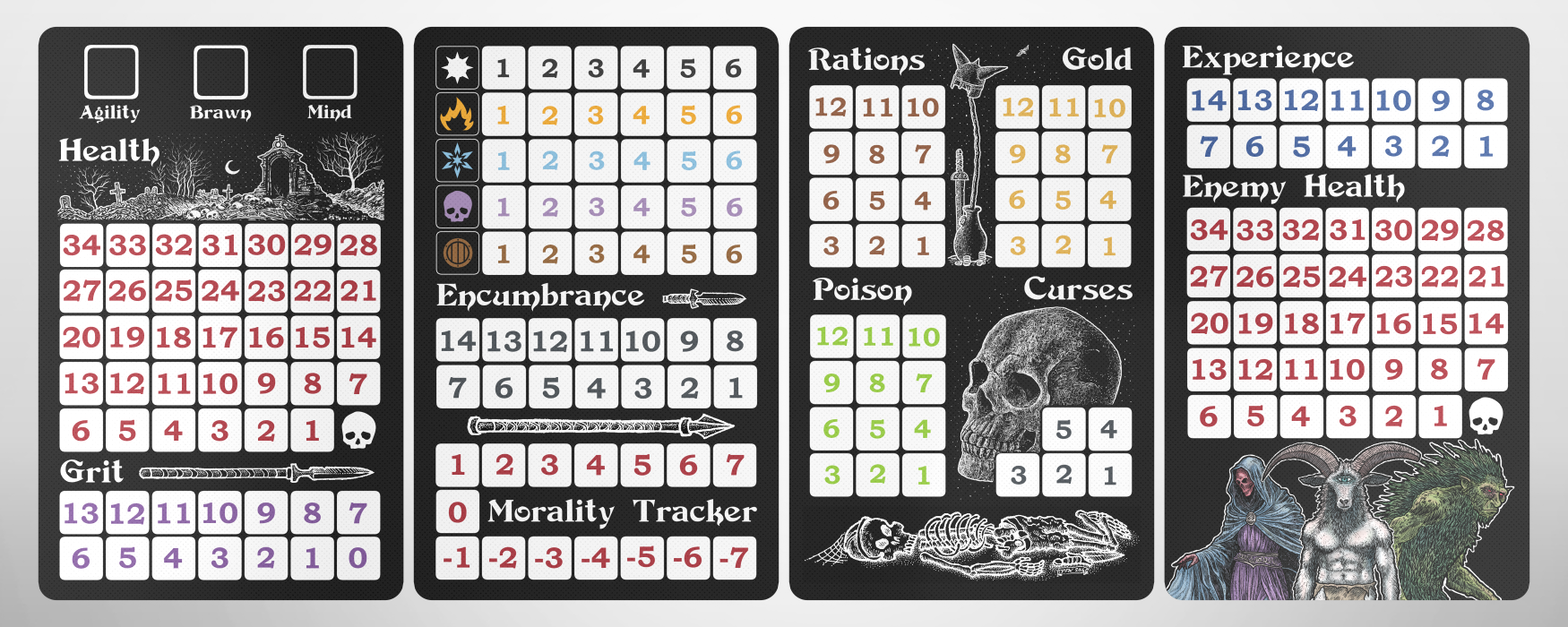
We also got rid of the smaller tracker cards and replaced them with larger ones which also now include a way to track your encumbrance. Doing this is what also freed up 7 poker-sized cards for the five new cards above and two more that we will dive into next. Here is a look at the 4 jumbo tracking cards. Also included now will be 3 blue dice for keeping track of your stats of Agility, Brawn, and Mind.
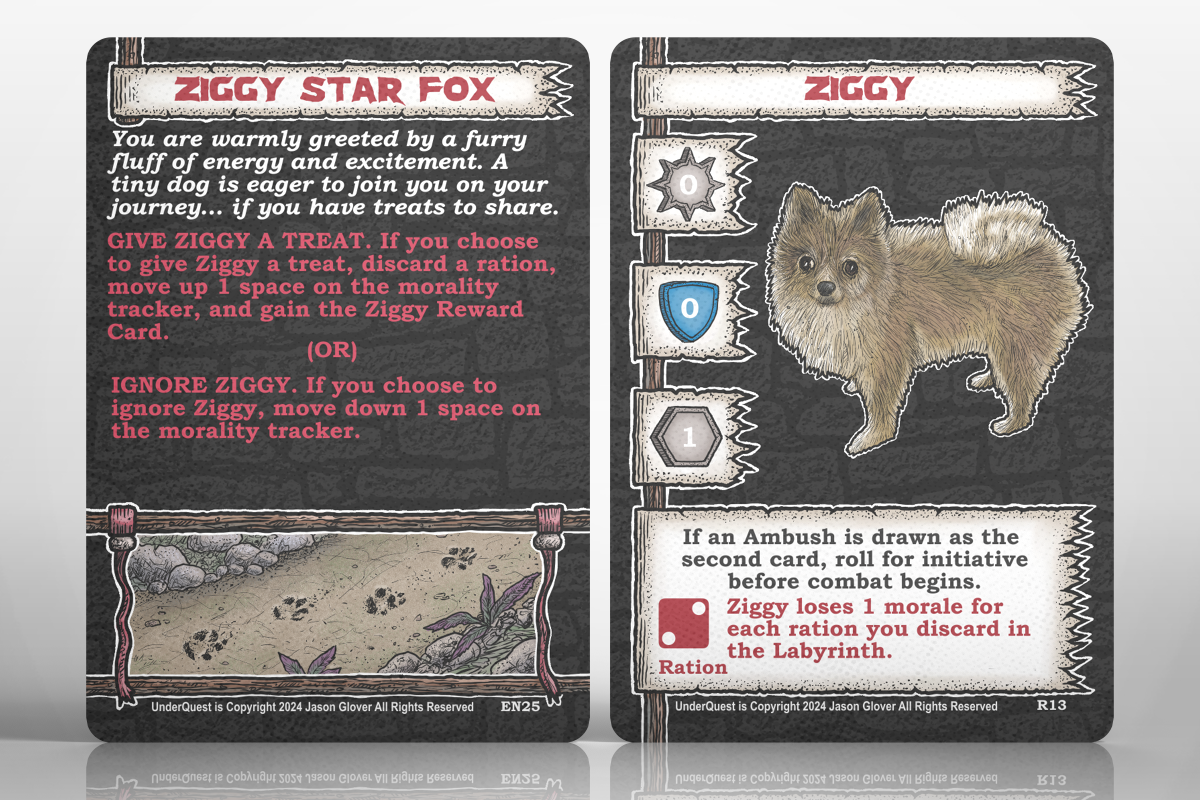
With the final two cards I decided to tip my hat to Dustin for his hard work and we added a Ziggy companion reward card and an encounter card that introduces him. Ziggy is a faithful companion that will warn you of an ambush.
There were also a few other small changes to some encounter cards to help balance the morality system and to some items to make them a bit better. The vast majority of the game remains the same. I am so glad I decided to cancel. I am sure everyone wants the best version of UnderQuest possible and we have it now. I am finishing up a few things like making final changes to the rulebook to reflect some of these changes. We are aiming to relaunch the Crowdsale in January. Stay tuned for that. We will have many videos out prior to the launch for folks to watch and see the new changes in action. Thanks for all of your support! Thanks!
The CrowdSale for UnderQuest went live a few hours ago and we have already passed the 500 backer mark! UnderQuest is now $28 off! Now will be the best time to pick up a copy. MSRP will be set at $79.99 and right now you can get your copy for just $51.35! If we hit 1000 backers in the next two weeks the price will drop again to $46.80 for every backer! Check out the page at the link below to learn more about the game. Thanks!
https://www.thegamecrafter.com/crowdsale/underquest

Mark your calendars! The CrowdSale for UnderQuest launches next Thursday (November 6th) at around 5pm CST! This has been a long journey, but we are finally here! Check out the CS page and hit the REMIND button. Thanks!
https://www.thegamecrafter.com/crowdsale/underquest
Tutorial videos will be dropping over the next few days and I have a copy on its way to the Game Knight for review. I am sure he will make a lot of videos for folks to watch. Also trying to get ahold of Daniel from the Dungeon Dive, but can’t seem to get a response yet, but hopefully that will be happening as well. Stay tuned and spread the word.
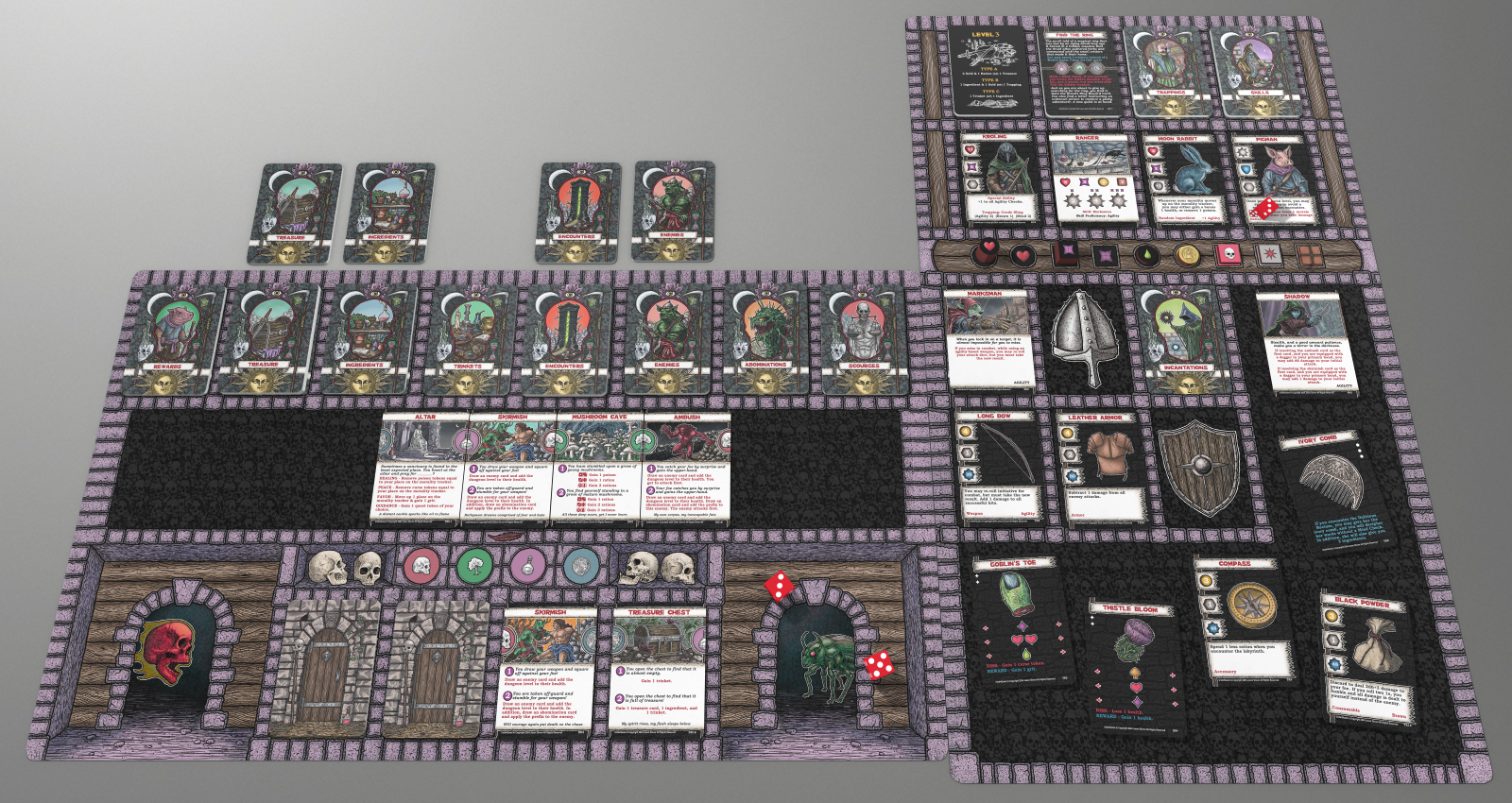
Well, after some thought I decided to share the raw file of the rulebook with everyone. This file is unedited. I feel like the old saying that it takes a village to raise a child applies here. UnderQuest is my baby and I am self aware enough to know that writing rulebooks is not my greatest strength as a game designer. So please feel free to read the rules and learn about the game and if you see a spelling or grammar issue, please leave a comment. I have copies out to proofreaders, but extra eyes never hurt. Enjoy and thanks!

The Game Crafter will be hosting the Cinco De Mayo Sale from May 1st through May 9th! This will be a great time to grab a game, or two, from our library of games at a nice discount, so mark those calendars!
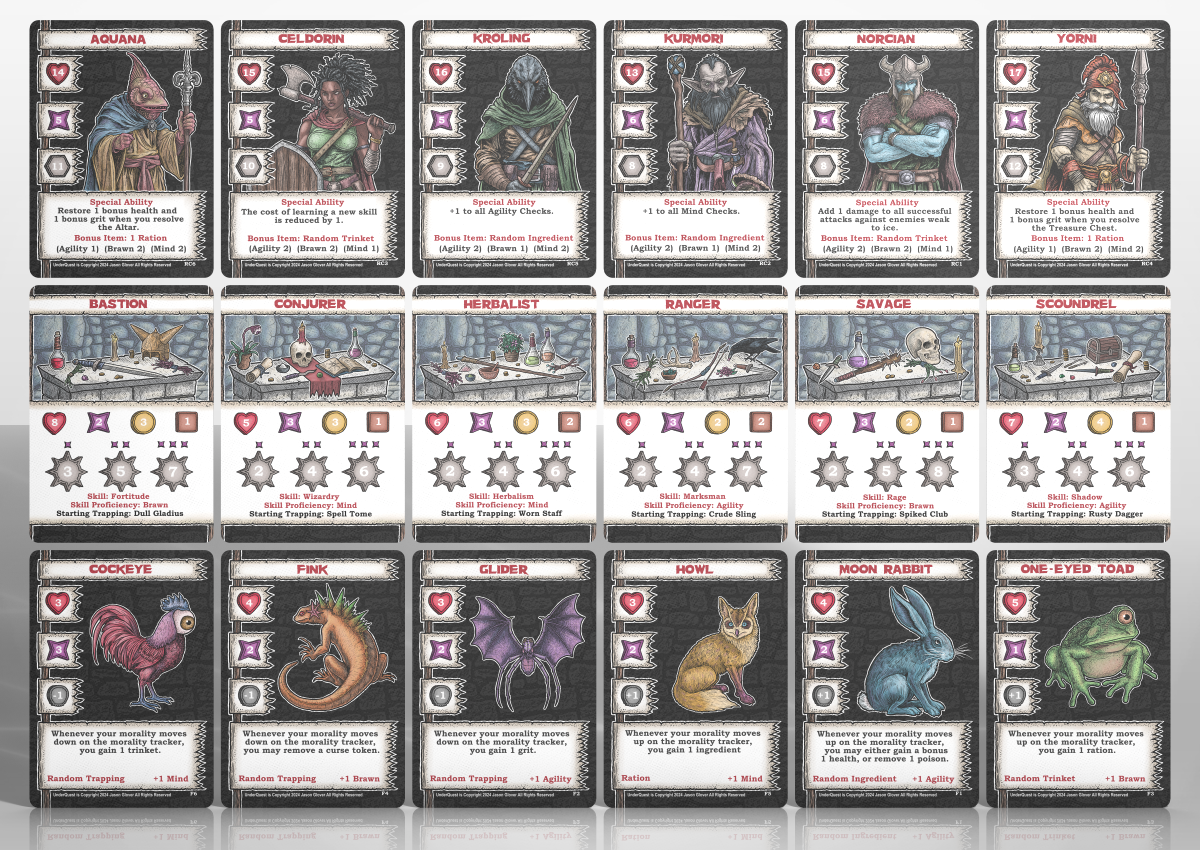
I thought it would be a good idea to explain exactly how you go about creating a character in UnderQuest. Building your adventurer at the beginning of your journey requires you to make 3 important choices. You must pick a Race, a Class, and a Familiar. Let’s take a look as to how this works.
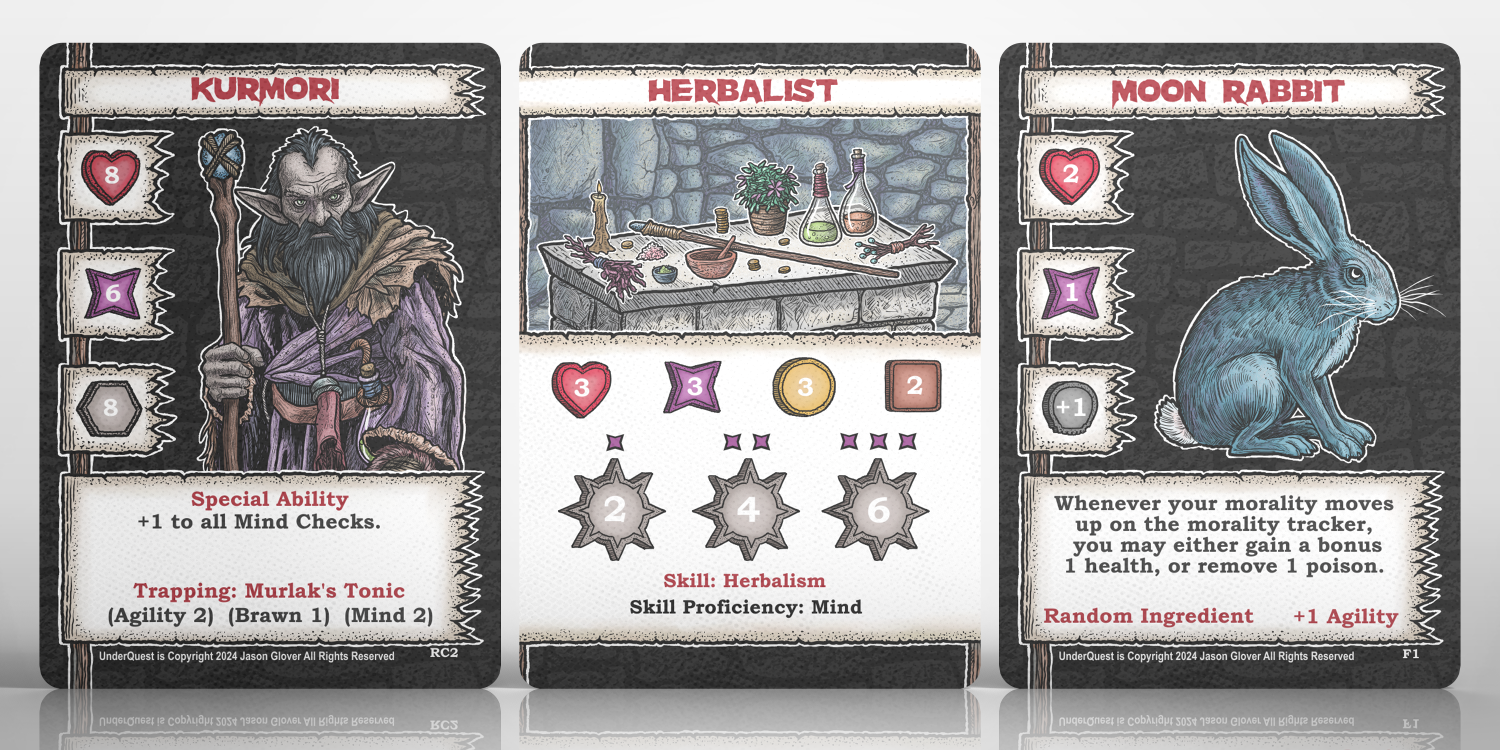
There are 6 races, 6 classes, and 6 familiars to choose from. The race and classes share opposite sides of the same card meaning that you cannot be both the race and class from a single card at the same time. Essentially, each race has a class that it cannot be. This is an older idea that I borrowed from old computer roleplaying games where certain races could not be certain classes. I simply like the concept. You can however choose any of the 6 familiars you like. So in the base game you will have 180 combos to explore!
Let’s take a look at the character we have build above, the Kurmori Herbalist, with a Moon Rabbit familiar. Each of the 3 cards help to determine your starting/max health (heart icon). 8+3+2= 13 starting/max health. Also you can figure your starting/max grit (purple star icon). 6+3+1= 10 starting max grit. Grit is similar to energy in my other designs. Now we shall look at each card individually to see how they make your character come to life.
The race card also determines your starting encumbrance. This is obviously important for being able to carry more items in your inventory. The Kurmori has a pretty low encumbrance, meaning you will have to balance carefully what you keep in your inventory. You will see that each race card has a special ability. In the case of the Kurmori, you gain +1 to all mind checks. There are a lot of mind checks in the game, so this is quite nice. He also starts with Murlak’s Tonic, which is a potion that cures poison based on your brawn stat. This character only has 1 brawn, so not a very helpful starting item, but could be sold to the merchant. Lastly, and most importantly, your race card tells us your starting stats (Agility, Brawn, and Mind). In this case the Kurmori has 2 agility, 1 brawn, and 2 mind.
Now let’s look at the class card. In addition to the health and grit buffs that we discussed earlier, your class will determine your starting trinkets (similar to gold in Iron Helm) and your starting rations. The Herbalist starts with 3 trinkets and 2 rations, which is above average. Trinkets are used to barter for items with merchants and at the Lonely Troll Inn before, and in between, adventures. Rations are consumed between dungeon levels and can be spent in a few others ways during your adventure, like for feeding wolves so they don’t attack you. In the middle of the class card, you will see 3 attack icons with values in them. Above each of those a small grit icons. This tells us how much bonus damage we can inflict in combat when we spend the corresponding amount of grit. The Herbalist is not an offensive powerhouse. Below that you will see your starting skill. In this case it is fittingly the Herbalism skill, which will make you better at crafting potions right out of the gate. Lastly, the class card tells us our skill proficiency. We gain experience during the game that we can trade in to learn new skills. It is always easier to learn a skill that falls into your skill proficiency. You can learn skills outside your proficiency, but it will cost you more experience.
The last card we have to examine is the familiar card. This is a mystically creature that is always nearby protecting you. They give you a minor buff to your starting/max health and grit, and they also set your starting placement on the morality tracker. Your familiar will influence your choices in regards to morality by offering you a perk for doing what they like. In the case of the Moon Rabbit, you can either have your health healed for 1 or you can remove 1 poison every time you move up on the morality tracker. You are being rewarded for being a good person. There are however evil familiars that do the opposite. You familiar will give you a bonus item at the start of the game as well. The Moon Rabbit gives you an ingredient, which is fitting for the Herbalist. Lastly, they give you a stat bonus, which is very powerful. The Moon Rabbit gives you a bonus to Agility, meaning your final starting stats are as follows: 3 Agility, 1 Brawn, and 2 Mind.
So what we end up with is a truly unique adventurer with some nice strengths and some clear weaknesses. Our Kurmori Herbalist and his Moon Rabbit will be challenged if equipped with a brawn-based weapon, struggle with decisions as to what items to drop and which to keep, and will generally have issues in combat with a lower health and lower damage output. On the plus side, he will do well with mind checks, can be armed with an agility-based weapon and succeed, and has above average grit, which will help is many ways. Each character you create will be similar, in that they will have strengths and weaknesses, and this will ultimately determine your strategies during play.
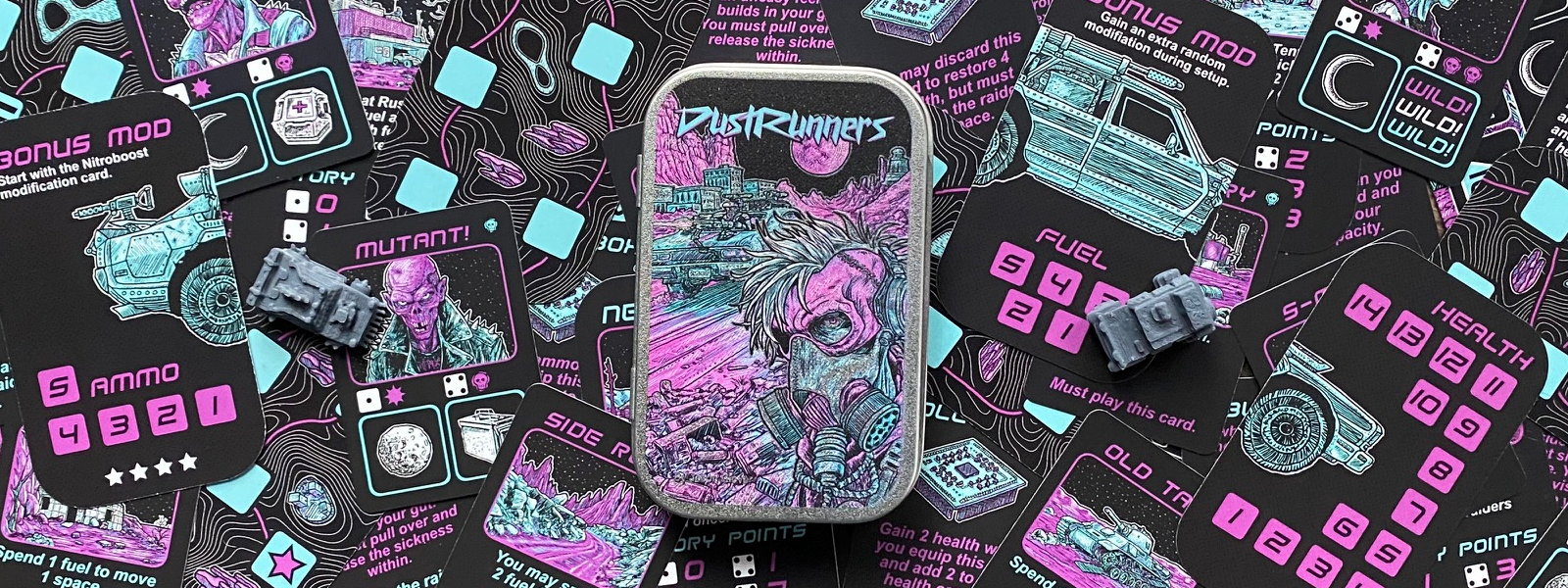
The Crowd Sale for Dustrunners launched a few days ago and we have already passed 600 backers! All copies are just $12.90 for all backers! You can get the base game (Dustrunner) for just $14.69! We are trying to reach 1000 backers and hit the final price drop. The sale ends on February 4th!
https://www.thegamecrafter.com/crowdsale/dustrunners
What does Dustrunners Add?
(1) Twelve new Exploration Cards have been added to the game that add many new loactions and enemies to deal with.
(2) Three new double-sided Vehicle Cards have been added, which increase the total number of possible combination of builds up to over 200!
(3) A new radiation mechanic has been added and this creates another level of tension and strategy to the game.
(4) New vehicle modification cards have been added and well as new some new resolution cards.
(5) Five all-new double-sided Map Cards have been added. One side is standard difficulty, while the other is hardcore mode!
(6) Along your journey across the wastland, you will now have the oppertunity to stop and trade at settlements along the way. Six Settlement Cards have been added!
(7) Lastly, you will receive a Race/Class Promo Card for Tin Helm/Tin Realm! Included is also the corrected Vile Shores card for Tin Realm.
(8) But wait, there’s more! As a small bonus, I have added 2 new dustrunner minis to the game that you can use to track your postion on the map cards and the position of the pesky raiders!
I hope you can take a moment to check out the Crowd Sale Page and share it with those that you think might find it interesting. Thanks again for the continued support.
-Jason Glover
Today we will be discussing the all-new quest system that will be used in UnderQuest. Unlike Iron Helm, in which you simply worked your way through the dungeon deck until you revealed enough eye icons to trigger the boss fight, UnderQuest tackles this task from a more narrative-driven angle. Let’s dive into how exactly this works.

UnderQuest uses a Quest Token system. Quest Tokens are gained in a few ways during play. (1) You can gain one by connecting two dungeon cards together in your dungeon tableau that complete an icon. When you do this, you gain the matching Quest Token. (2) You can also gain a quest token during a random encounter. These Quest Tokens are then spent to progress through the quest deck. Let’s talk about the quest deck.
The quest deck is actually made up of 6 smaller decks. Each of these smaller decks represents a phase of your adventure and are numbered 1-6 on their backside. During game setup you randomly select one card from each of these decks, without looking at them, and then stack them in order with the card from the 6th phase on the bottom. You will then reveal the top card and you are ready to start your adventure.
Each card has an upper narrative portion that sets up the scene. In the middle you will find the three Quest Tokens you must locate and then spend to unlock the lower portion of the card. The lower portion concludes the phase of the adventure and sometimes offers special loot, healing, or perhaps a companion to join your mission.
The core game will come with 3 cards in each of the 6 phases for a total of 18 cards. having a random card pulled for each phase creates a new story every time. In fact, with just 18 cards you manage to have over 700 possible pathways through your quest’s story. This creates a very high replay level for the game. I also plan on releasing Quest Packs in the future, that will add 1 card from each phase. So if we go from 3 cards in each of the 6 decks to 4 cards we increase the possible story paths from 729 combinations, to 4096!!! The plan is to add many of these decks over time, which should translate into almost an endless numbers of unique adventures.
I am pretty excited about this system as it will allow there to be a story that drives the game, and when you combine this with the random encounter deck and other mechanics in the game like the alchemy system, you should have a unique adventure every time you open up the box. I am excited to share more about UnderQuest as it develops. Thanks for stopping by and hanging out!
I want to discuss how the alchemy system works in the upcoming UnderQuest. My goal was to create a crafting system that allows the players to really make decisions as to exactly what sort of potions they want to make. Below is an example of two ingredient cards. Let’s take a look at exactly how this system works.

So here we have the Nether Cabbage and Goblin’s Toe ingredients. You will notice some symbols and text on these cards that may not make sense at first glance, but I hope to clear it all up for you. To craft a potion you need at least two ingredients. All ingredient have three rows of symbols and these symbols tell us what effects each ingredient offers.
The Nether Cabbage has three heart symbols (each one heals 1 health) on the top row, a mushroom symbol (provides 1 food) in the middle row, and a cross symbol (cures 1 curse) on the bottom row. The Goblin’s Toe has a diamond symbol (gain 1 grit) on the top row, two heart symbols in the middle row, and a drop symbol (cures 1 poison) on the bottom row. In the top left corner of each card you will see the ingredient’s difficulty to use value. The Nether Cabbage has a value of 2, while the Goblin’s Toe has a value of 1. Lastly, at the bottom of each card we have the risks and rewards of using each ingredient.
So how does this all work?
The first thing you will do is place both cards side by side, so that the three rows line up. You will look to see if any of the symbols match up on any of the given rows. In the case of these two ingredients, they do not. But you notice that if you pushed the Goblin’s Toe card up one slot so that its middle row lined up with the top row of the Nether Cabbage, that you would create a row of 5 hearts! That would heal 5 health if successfully crafted. You able to shift cards in this way, but at cost. Each time you shift a card up or down, you must increase the total difficulty of crafting by 1 point. Using these two ingredients have a total of 3 difficulty if you add the two cards together., but since we had to shift the rows one slot, that 3 difficulty, becomes 4.
Now if it time to attempt to craft this potion. You simply roll d6 and add your Mind stat. If you meet, or exceed, the difficulty value, then you successfully craft the potion and immediately gain 5 health and discard both cards. However, you could craft an exquisite version of the potion, if you happen to roll a natural 6. In this case, you can choose one of the rewards shown on the ingredients being used. In the case of these two ingredients, we could either keep one of the ingredients instead of discarding it, or we could gain a bonus 1 grit. Good job!
But what if we fail? If you roll, and the sum of your roll and Mind stat are below the value of 4 to craft this particular potion, you fail. You must discard both cards, but before you do that you must suffer a risk for having failed. Simply flip both ingredients over and shuffle and pick one at random. You must suffer the risk indicated on this card. In this case, you might gain 1 poison or perhaps 1 curse token.
Lastly, there will be a host of skills that your adventurer may learn that will help you craft potions more effectively, and even allow you to use more than 2 ingredients. More details on that to come.
 Grey Gnome Games