Creating a Character in UnderQuest

I thought it would be a good idea to explain exactly how you go about creating a character in UnderQuest. Building your adventurer at the beginning of your journey requires you to make 3 important choices. You must pick a Race, a Class, and a Familiar. Let’s take a look as to how this works.
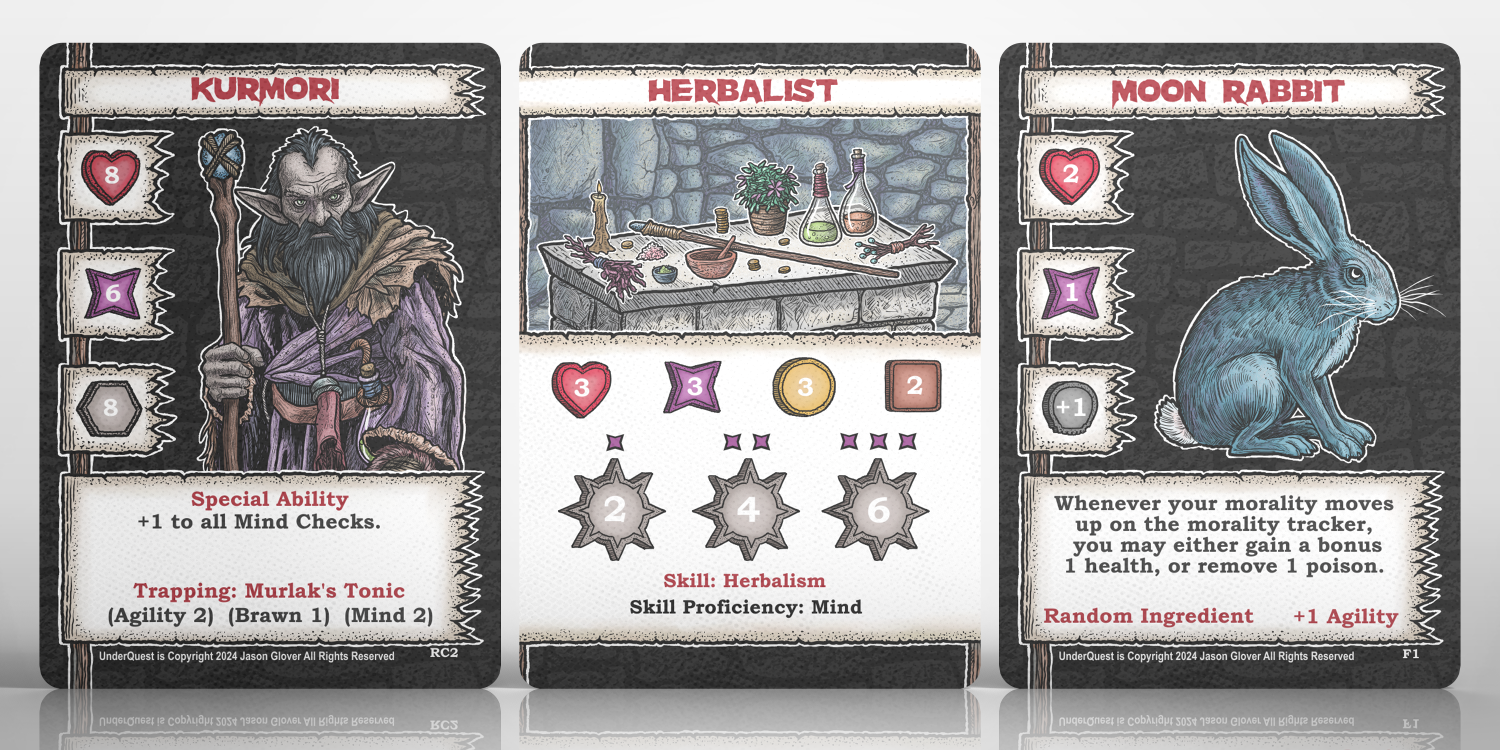
There are 6 races, 6 classes, and 6 familiars to choose from. The race and classes share opposite sides of the same card meaning that you cannot be both the race and class from a single card at the same time. Essentially, each race has a class that it cannot be. This is an older idea that I borrowed from old computer roleplaying games where certain races could not be certain classes. I simply like the concept. You can however choose any of the 6 familiars you like. So in the base game you will have 180 combos to explore!

Let’s take a look at the character we have build above, the Kurmori Herbalist, with a Moon Rabbit familiar. Each of the 3 cards help to determine your starting/max health (heart icon). 8+3+2= 13 starting/max health. Also you can figure your starting/max grit (purple star icon). 6+3+1= 10 starting max grit. Grit is similar to energy in my other designs. Now we shall look at each card individually to see how they make your character come to life.

The race card also determines your starting encumbrance. This is obviously important for being able to carry more items in your inventory. The Kurmori has a pretty low encumbrance, meaning you will have to balance carefully what you keep in your inventory. You will see that each race card has a special ability. In the case of the Kurmori, you gain +1 to all mind checks. There are a lot of mind checks in the game, so this is quite nice. He also starts with Murlak’s Tonic, which is a potion that cures poison based on your brawn stat. This character only has 1 brawn, so not a very helpful starting item, but could be sold to the merchant. Lastly, and most importantly, your race card tells us your starting stats (Agility, Brawn, and Mind). In this case the Kurmori has 2 agility, 1 brawn, and 2 mind.

Now let’s look at the class card. In addition to the health and grit buffs that we discussed earlier, your class will determine your starting trinkets (similar to gold in Iron Helm) and your starting rations. The Herbalist starts with 3 trinkets and 2 rations, which is above average. Trinkets are used to barter for items with merchants and at the Lonely Troll Inn before, and in between, adventures. Rations are consumed between dungeon levels and can be spent in a few others ways during your adventure, like for feeding wolves so they don’t attack you. In the middle of the class card, you will see 3 attack icons with values in them. Above each of those a small grit icons. This tells us how much bonus damage we can inflict in combat when we spend the corresponding amount of grit. The Herbalist is not an offensive powerhouse. Below that you will see your starting skill. In this case it is fittingly the Herbalism skill, which will make you better at crafting potions right out of the gate. Lastly, the class card tells us our skill proficiency. We gain experience during the game that we can trade in to learn new skills. It is always easier to learn a skill that falls into your skill proficiency. You can learn skills outside your proficiency, but it will cost you more experience.

The last card we have to examine is the familiar card. This is a mystically creature that is always nearby protecting you. They give you a minor buff to your starting/max health and grit, and they also set your starting placement on the morality tracker. Your familiar will influence your choices in regards to morality by offering you a perk for doing what they like. In the case of the Moon Rabbit, you can either have your health healed for 1 or you can remove 1 poison every time you move up on the morality tracker. You are being rewarded for being a good person. There are however evil familiars that do the opposite. You familiar will give you a bonus item at the start of the game as well. The Moon Rabbit gives you an ingredient, which is fitting for the Herbalist. Lastly, they give you a stat bonus, which is very powerful. The Moon Rabbit gives you a bonus to Agility, meaning your final starting stats are as follows: 3 Agility, 1 Brawn, and 2 Mind.

So what we end up with is a truly unique adventurer with some nice strengths and some clear weaknesses. Our Kurmori Herbalist and his Moon Rabbit will be challenged if equipped with a brawn-based weapon, struggle with decisions as to what items to drop and which to keep, and will generally have issues in combat with a lower health and lower damage output. On the plus side, he will do well with mind checks, can be armed with an agility-based weapon and succeed, and has above average grit, which will help is many ways. Each character you create will be similar, in that they will have strengths and weaknesses, and this will ultimately determine your strategies during play.

Let’s Make Goblin Toe Salad!

I want to discuss how the alchemy system works in the upcoming UnderQuest. My goal was to create a crafting system that allows the players to really make decisions as to exactly what sort of potions they want to make. Below is an example of two ingredient cards. Let’s take a look at exactly how this system works.

So here we have the Nether Cabbage and Goblin’s Toe ingredients. You will notice some symbols and text on these cards that may not make sense at first glance, but I hope to clear it all up for you. To craft a potion you need at least two ingredients. All ingredient have three rows of symbols and these symbols tell us what effects each ingredient offers.

The Nether Cabbage has three heart symbols (each one heals 1 health) on the top row, a mushroom symbol (provides 1 food) in the middle row, and a cross symbol (cures 1 curse) on the bottom row. The Goblin’s Toe has a diamond symbol (gain 1 grit) on the top row, two heart symbols in the middle row, and a drop symbol (cures 1 poison) on the bottom row. In the top left corner of each card you will see the ingredient’s difficulty to use value. The Nether Cabbage has a value of 2, while the Goblin’s Toe has a value of 1. Lastly, at the bottom of each card we have the risks and rewards of using each ingredient.

So how does this all work?

The first thing you will do is place both cards side by side, so that the three rows line up. You will look to see if any of the symbols match up on any of the given rows. In the case of these two ingredients, they do not. But you notice that if you pushed the Goblin’s Toe card up one slot so that its middle row lined up with the top row of the Nether Cabbage, that you would create a row of 5 hearts! That would heal 5 health if successfully crafted. You able to shift cards in this way, but at cost. Each time you shift a card up or down, you must increase the total difficulty of crafting by 1 point. Using these two ingredients have a total of 3 difficulty if you add the two cards together., but since we had to shift the rows one slot, that 3 difficulty, becomes 4.

Now if it time to attempt to craft this potion. You simply roll d6 and add your Mind stat. If you meet, or exceed, the difficulty value, then you successfully craft the potion and immediately gain 5 health and discard both cards. However, you could craft an exquisite version of the potion, if you happen to roll a natural 6. In this case, you can choose one of the rewards shown on the ingredients being used. In the case of these two ingredients, we could either keep one of the ingredients instead of discarding it, or we could gain a bonus 1 grit. Good job!

But what if we fail? If you roll, and the sum of your roll and Mind stat are below the value of 4 to craft this particular potion, you fail. You must discard both cards, but before you do that you must suffer a risk for having failed. Simply flip both ingredients over and shuffle and pick one at random. You must suffer the risk indicated on this card. In this case, you might gain 1 poison or perhaps 1 curse token.

Lastly, there will be a host of skills that your adventurer may learn that will help you craft potions more effectively, and even allow you to use more than 2 ingredients. More details on that to come.

Abominations (AKA Minibosses)

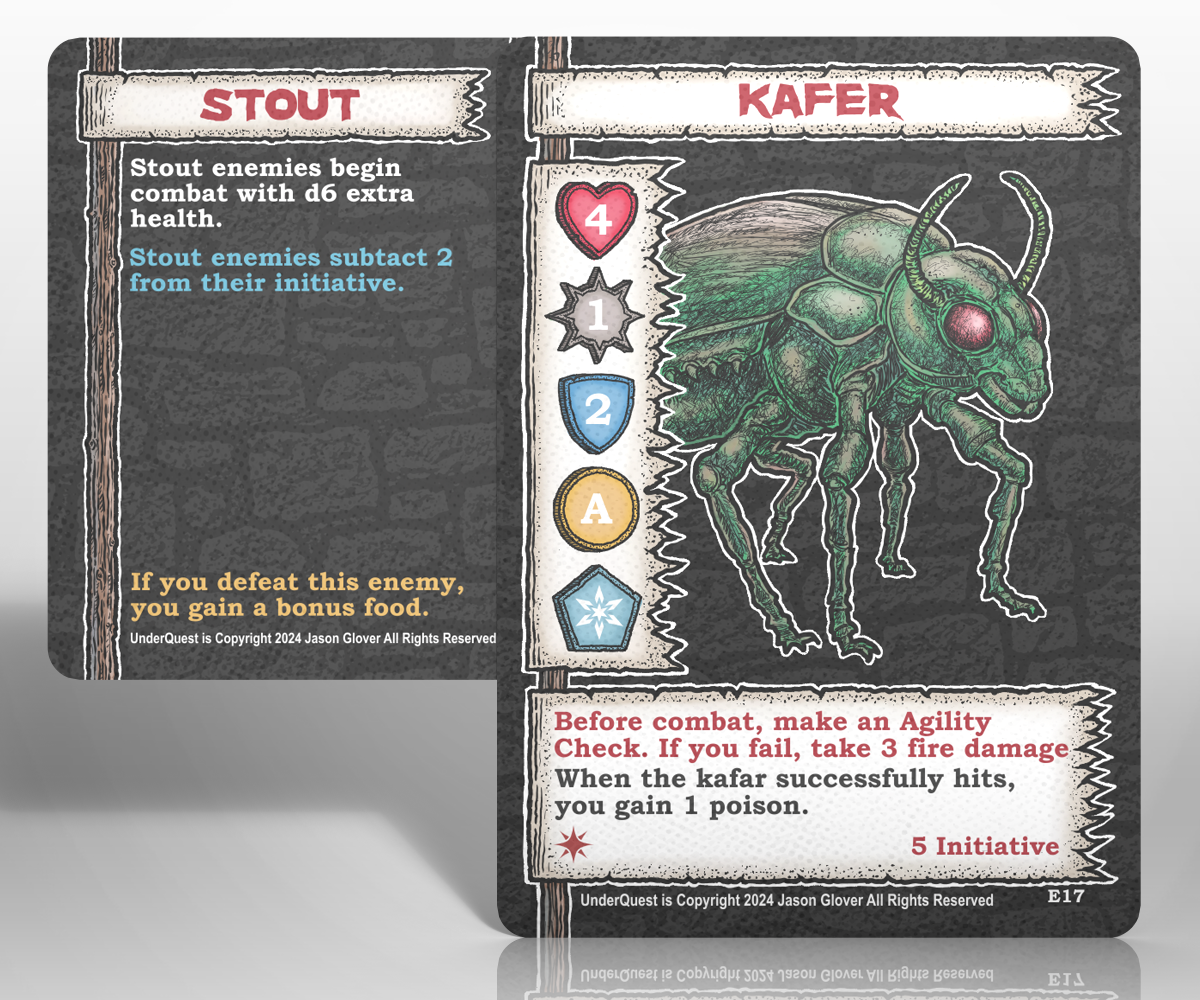
UnderQuest will include a 10 card Abominations deck. This deck will be used to augment standard enemy cards and make the foe deadlier. In most cases you will only be adding the prefix (left) portion to enemy cards, but in the case of the exalted foe dungeon card, you will have to add both the prefix from one card and the suffix from another card. This essentially creates a miniboss. The prefix side refers to a description of the enemy. Are they physically stronger or faster, or are they undead or have elemental power. The suffix side refers to which spiritual plane they are aligned with. This will boost the enemy in many powerful ways as you can see below. With 18 enemy cards and 10 abomination cards the number of combinations for enemies is virtually endless. Let’s take a look at a couple examples of an Abomination card.

Here we have two examples of Abomination cards. On the left of each card is the prefix portion of the card and this is added to an enemy card often when you get into combat after drawing the second card in the dungeon deck on your turn. In rare occasions you will also have to add the right (suffix) portion of the card as well. You will never be asked to add the suffix portion without the prefix portion. The prefix side always adds a bonus power, but also a weakness to the enemy. Both the prefix and suffix sides add bonus treasure if the enemy is defeated. This feeds into the idea of the greater the risk, the greater the reward. Let’s take a look at an enemy that has had just the prefix added to it.

Here we have a relatively average enemy in the Kafar. This fellow has a chance of hitting you a fire attack at the beginning of combat and can poison you if they successfully hit. He does have some good defense as well. Now add the stout prefix and he becomes a bit more beefy, potentially adding 6 health. Extra health, in combination with a strong defense, make this guy a pretty tough foe. with 18 enemy cards in the base game and 10 Abomination cards, you have a total of 180 potential combos! Now lets look at some minibosses. Muhahahahaha!

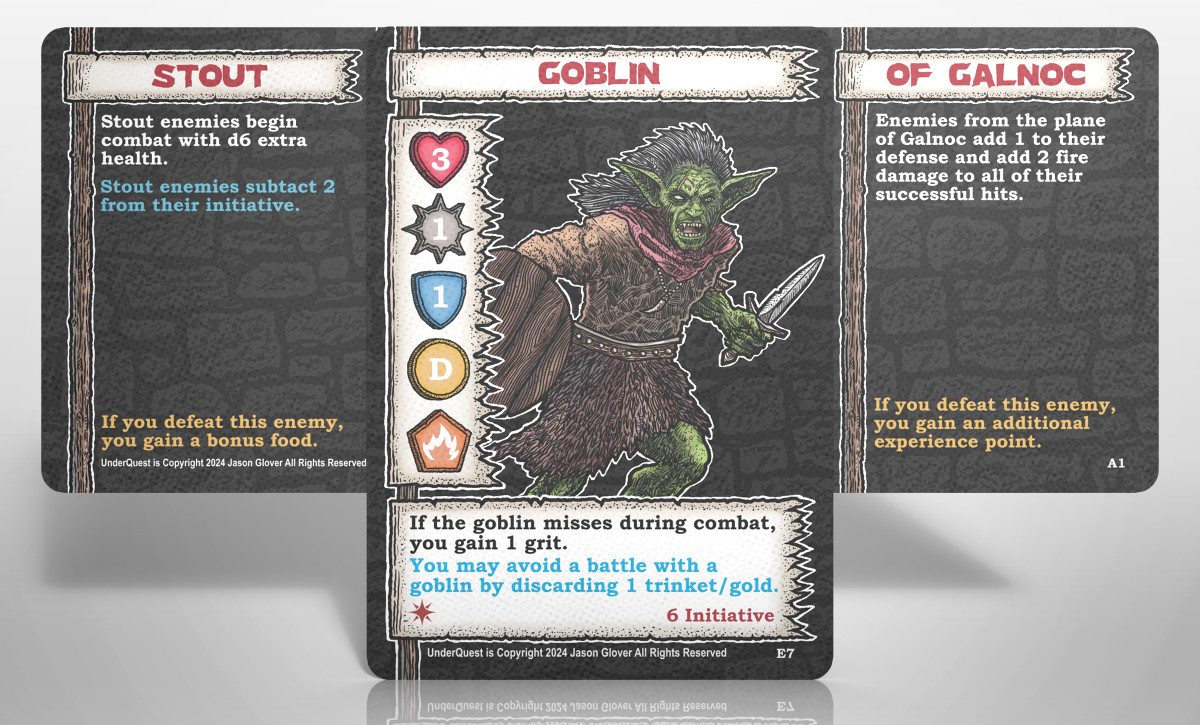
Here we have the fairly weak Goblin that has been elevated to a miniboss that is not so weak anymore. He gains the d6 extra health from the stout prefix and gains 1 defense from the suffix side. He will also add 2 fire damage to all successful hits. On the plus side, his 6 initiative drops to 4. Maybe not the scariest miniboss, but definitely puts him up there with some of the stronger base enemies. Now lets use the same two prefixes and suffixes on a stronger base enemy to create a formidable miniboss.

In the example we get a Stout Wraith of Glanoc! This gal is quite terrifying. She already has the ability to heal every time she successfully hits and now she starts out with extra health and defense! Successful hits also deal 2 fire damage! Now this is not something you want to tangle with. Let’s look at another example.

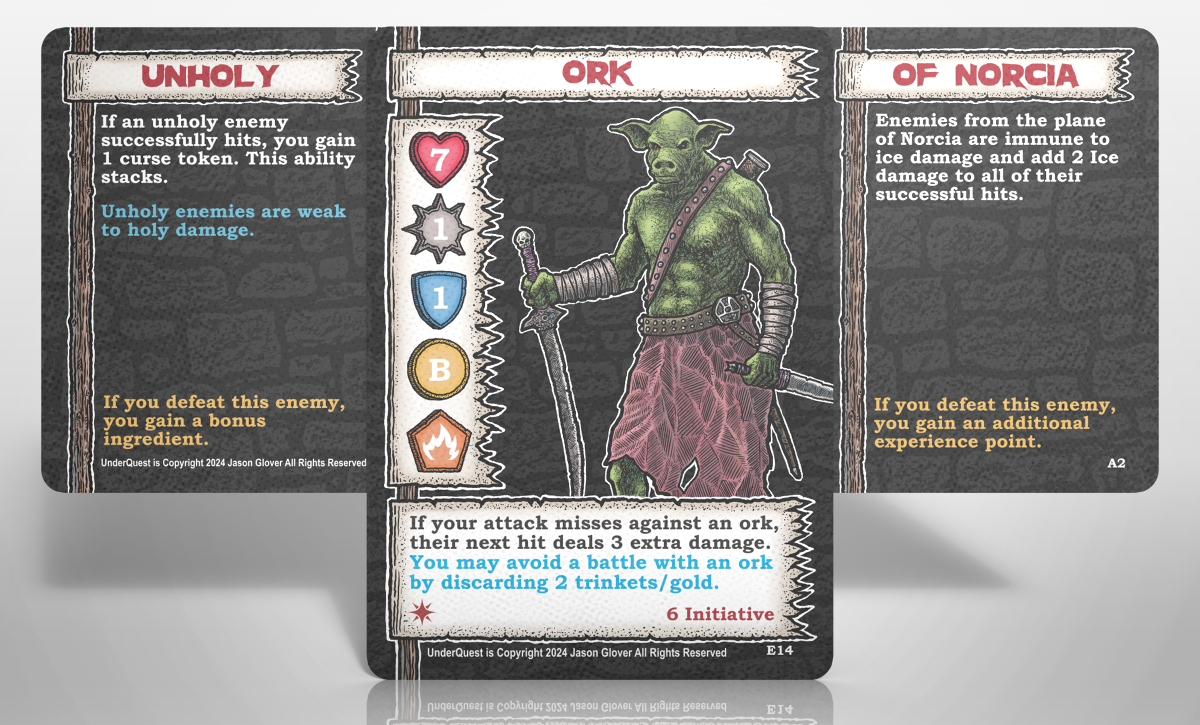
Here we have an Unholy Orc of Norcia! This is an undead orc that is weak to both fire and holy damage, which could prove useful for us. However, you will be gaining a curse token and taking 2 ice damage every time he hits! He is also immune to ice damage, but that likely is not a huge deal. Now lets use the same two Abomination cards and swap out the enemy with one that really becomes an issue.

The Unholy Shade of Norcia is a prime example of how the certain Abomination cards work really well with certain enemy cards to create some boss-level enemies. The absolute scariest part about this guy is that you gain 2 curse tokens every time this foe successfully hits, along with 2 ice damage. Unholy make him weak to holy attacks, but he was already weak to holy attacks, so there is no real gain there for you. He is also now immune to all ice damage. Let us not forget that the shade has an imitative of 8, which means he is likely striking first. Yikes!

Thanks for taking the time to learn about the Abomination deck. I am very excited with how this simple 10 card deck has the ability to take 18 enemies and make hundreds of potential foes out of them. Stay tuned, there is more to come…